
In the late 1990s, when Napa had already become synonymous with prestigious American wine, another kind of fire was burning on the rocky hills of Paso Robles, between San Francisco and Los Angeles. A handful of passionate young people dreamed of making great wines here from Rhône Valley varieties—Syrah, Grenache and Mourvèdre—without being bound by tradition or regulatory constraints. They gathered around the bar of a dusty restaurant in the town center, tasted coveted wines from faraway places, and dreamed. Some had no prior experience in winemaking or agriculture; what they did have was a love of wine and a fierce determination to create something from nothing.
Paso Robles was an unlikely starting point for a quality revolution. Zinfandel had been grown here for generations, and Cabernet Sauvignon had established its position. But the newcomers refused to settle on a single identity. One arrived from Bordeaux, determined to do what he could not do in his homeland: blend Cabernet with Syrah. Another wanted to bring Zinfandel into blends with Rhône varieties. Yet another sought to make varietal wines from different vineyard parcels, each expressing itself so differently that every wine told its own story. The boundaries between the old schools of winemaking began to dissolve; the glass became the ultimate judge.
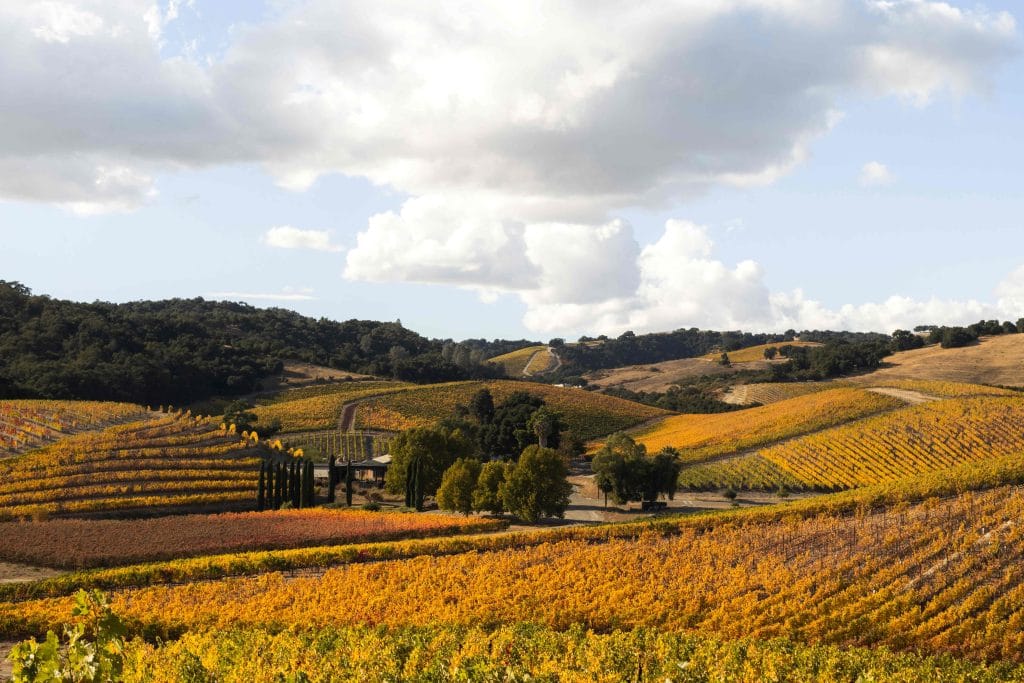
The geography encouraged experimentation as well. Paso Robles lies on the inland side of the Santa Lucia Range. Hot, sunny days allow grapes to ripen generously, while temperatures drop sharply at night as cool ocean air moves inland. There is no single terroir here, but a mosaic of growing areas, officially recognized in 11 sub-appellations.
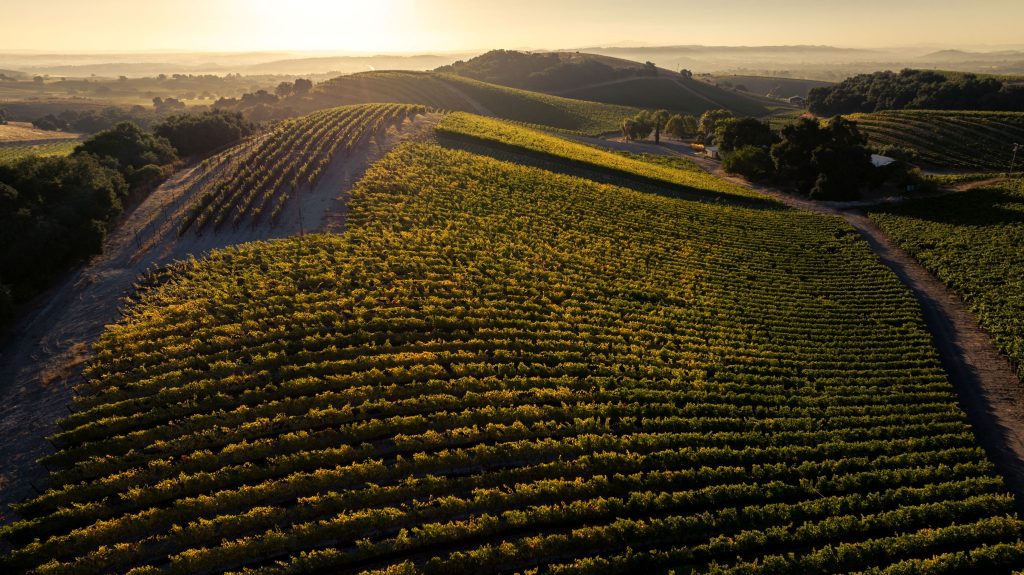
After a series of tastings at leading wineries in the region, what surprised me most was the quality of the wines and the breadth of their expression. I encountered assertive, sometimes peppery Syrah that retained its elegance; Grenache with generous fruit and a supple texture; Mourvèdre that contributed depth and spice; Zinfandel that offered more than simple fruit sweetness; and Cabernet that found common ground with varieties outside its traditional circle. Above all, I was impressed by the unconventional blends. Rather than obscuring the identity of the individual grapes, the most successful combinations added another dimension to each. Not every wine was equally balanced, but the standard of the best was unexpectedly high.
Nearly 30 years later, the rebels are no longer young men. Their wineries are established, their names are spoken by wine critics around the world, and at several estates the generational handover is beginning. Chloé Asseo now runs L’Aventure; Justin and Heather Smith’s children are becoming involved at Saxum; the Armstrong daughters hold management positions at Epoch; and Matt Trevisan is discovering that his children have absorbed, since childhood, knowledge no school could teach. The founders remain present, but now face a new challenge: passing on not only a successful winery, but also the freedom to take risks.

Linne Calodo — The Brother Who Parted Ways and the Winery That Became a Family
“Nature doesn’t make varietal wines. It makes blends.”
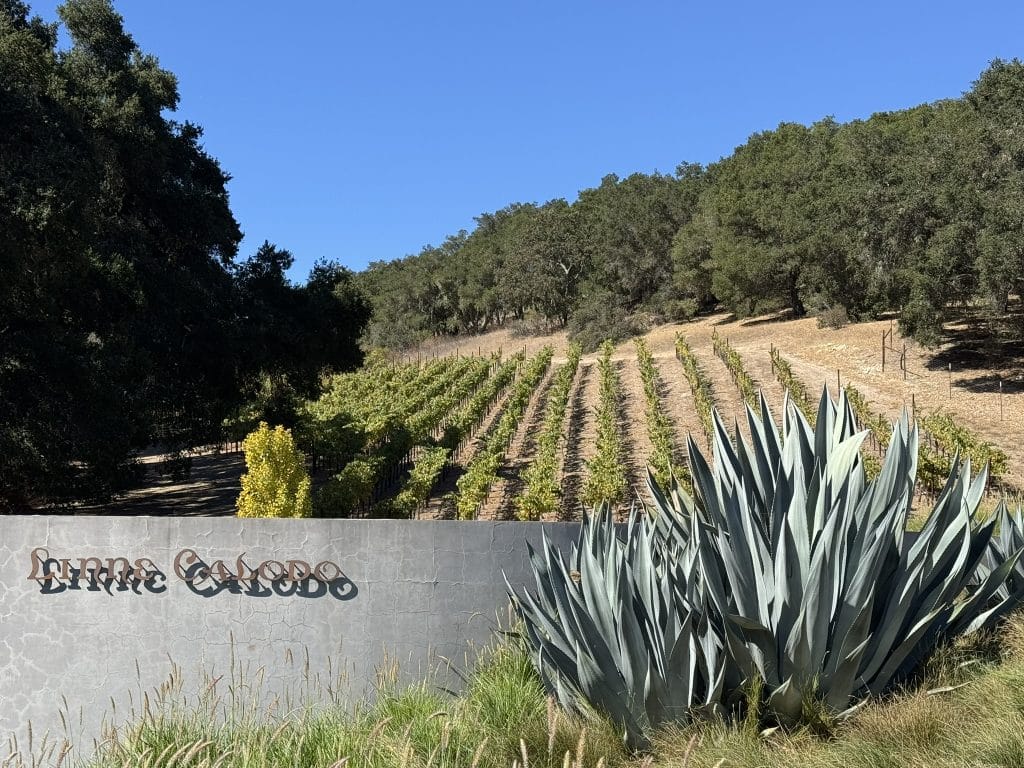
Wine on the Night Shift
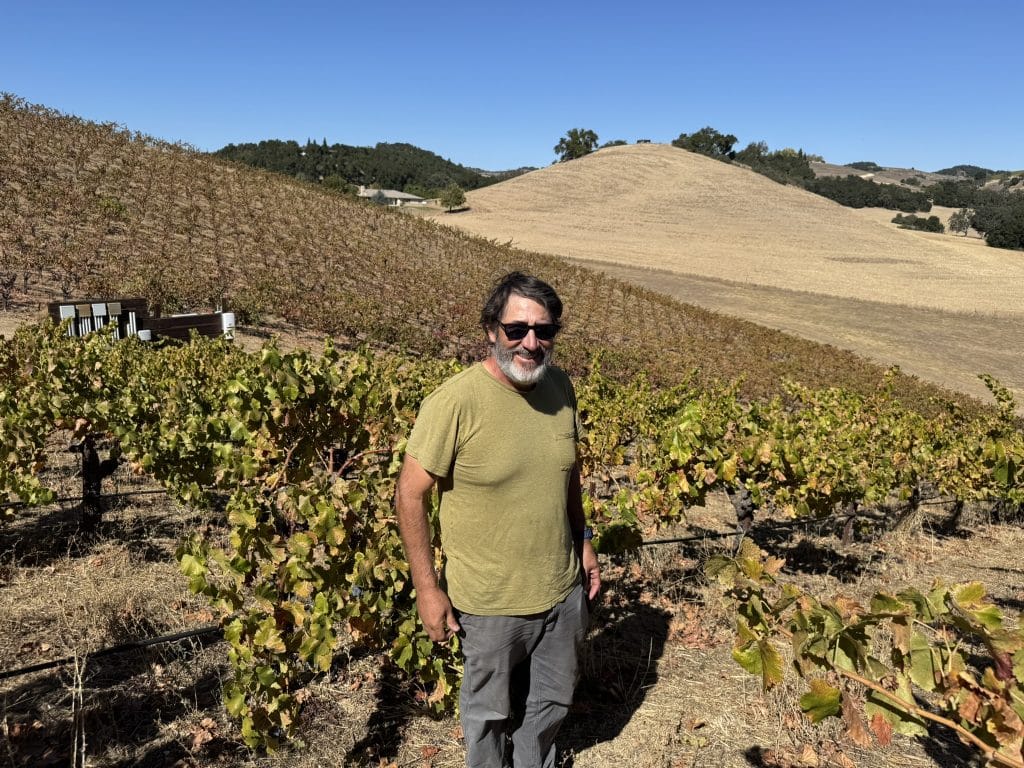
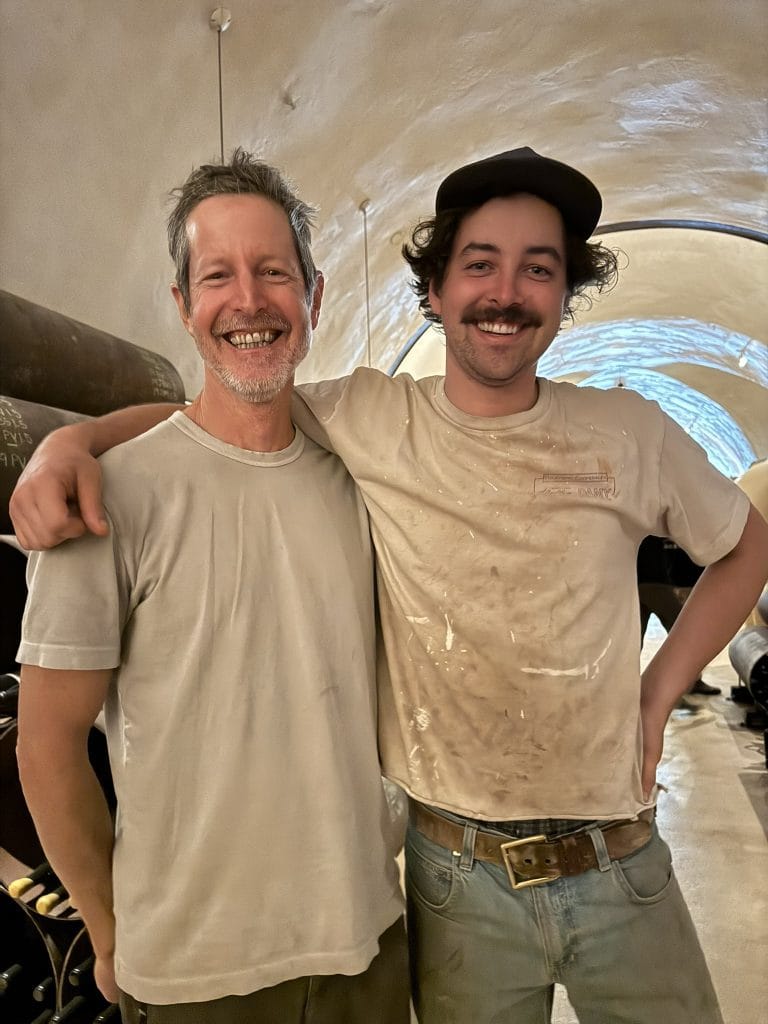
When Matt Trevisan arrived in California to study, he intended to become an aeronautical engineer. Eventually he traded aircraft for biochemistry, and the laboratory for vineyards. Asked at a job interview whether he knew how to drive a forklift, he replied that he did not—but since he knew how to fly a plane, he was sure he could learn. In 1998, he began making wine with his friend and roommate Justin Smith, later the founder of Saxum. They harvested grapes in the morning, worked at the winery during the day, and made their own wine at night after the other workers had gone home. Sometimes they finished at two in the morning.
Matt financed his first vineyard purchase in an unconventional way. He invested $4,000—saved dollar by dollar during a period when he even slept in his car—in shares of the internet companies AOL and Yahoo. When the investment grew to roughly $14,000, he sold the shares and paid for the vinyard, shortly before the dot-com bubble burst.
A Parting of Brothers
Matt and his wife Maureen Trevisan bought land where they hoped to establish their own winery. By then, their dreams no longer aligned with those of Justin and his wife Heather, and the couples went their separate ways. The gossip surrounding the split and the struggle over grape sources, were especially painful for Matt. Their relationship endured years of tension, but today he speaks of Justin as a brother who will always be part of his family. He also remembers who gave him his first winemaking book: Justin’s father.
The Smith family’s most profound influence on him was not, in fact, professional. Watching parents and son work together in the vineyard, talking and sharing the working day, Matt realized that this was the life he wanted for himself and his family.
Listening to the Barrel
Matt believes that the second generation has a practical advantage over trainees fresh out of winemaking school. Children raised among vineyards and barrels accumulate knowledge throughout their lives. What once felt like unwanted chores can later become valuable expertise—and the foundation for a rewarding career. When his 21-year-old daughter recently claimed that she knew nothing about making wine, he listed everything she had learned since childhood, from pruning and harvesting to managing fermentations. He also teaches his children to listen to a barrel and smell the wine: knowledge transmitted through the senses, not merely through books.
Establishing a family generational business
Not a Single Variety, but an Entire Story
“Nature doesn’t make varietal wines. It makes blends,” is how Matt sees it. Grenache brings floral notes, Mourvèdre an earthy character, and Syrah depth and structure. Even the names of the wines reveal something of his inner world. Overthinker refers to his tendency to analyze things over and over, sometimes without ever reaching a conclusion. Sticks & Stones takes its name from the rocks in the vineyard, but also from the hurtful words exchanged after his separation from Justin.
Working with mother nature
The tasting brought that philosophy to life. Nemesis 2021 was the standout for me: powerful yet harmonious, layered and rich in fruit. Nemesis 2023 was fruitier and rounder, but had not yet reached the complexity of its older sibling.
Linne Calodo Wine Tasting
Wine | My Score | My Tasting Notes | Critics’ Scores |
In My Dreams 2023 | 93 | Intense on the palate; medium-to-full body, length and grip, with ample tannins. | RP 95+ |
Overthinker 2023 | 93–94 | Abundant fruit, full body and intensity, with length and a lingering fruit presence; a comparatively restrained nose. | RP 95+ |
Nemesis 2021 | 95 | Impressive, layered and fruit-rich. A distinctive nose with a possible hint of eucalyptus; powerful yet harmonious. | WE 96; RP 95+ |
Nemesis 2023 | 94 | Fruitier and rounder than the 2021, but not yet as complex. | JD 98; RP 96 |
Sticks & Stones 2021 | 94–95 | A lovely wine; delicate fruit aromas with a hint of complexity, full body, generous fruit and a very fine finish. | JD 97; WS 94 |
Problem Child 2020 | 93–94 | A deep, warm nose with some complexity; expansive, rich and powerful on the palate, with tannins and good length. | RP 95; VN 95 |
RP – Wine Advocate; WE – Wine Enthusiast; JD – Jeb Dunnuck; WS – Wine Spectator; VN – Vinous.

Saxum
“I love combining the pepper and spice of Syrah with California’s roundness and power.”
From His Father’s Vineyard to the Summit of the Wine World
As a boy, Justin Smith helped his parents plant and prune vines and practically swore he would not spend his entire life doing it. Ironically, it was his college friends—who were captivated by the vineyard when they came to help—that made him see its beauty anew. When he returned home after studying botany and ecology, his father gave him a difficult Syrah parcel to manage. There was no money to pay him a salary for tending the vines. “Take that Syrah block on the hillside and do whatever you want with it—that’s your pay,” his father told him. The parcel gave birth to Bone Rock, one of the winery’s flagship wines. Justin had grown up in this terroir and watched for years as the fruits of his parents’ labor disappeared into generic California blends with no sense of place. After tasting two of the world’s greatest Syrah wines, he decided that this was the kind of wine he wanted to create. Making wine himself was a way to prove his own ability, but also to offer a new interpretation of the region where he grew up.
In 2010, Wine Spectator named Saxum’s 2007 James Berry Vineyard its Wine of the Year, following a 100-point score from Robert Parker. The achievement brought extraordinary international recognition to Saxum and Paso Robles. In an article published after the great success of the 2007 vintage, Justin said that although critics had awarded the wine a perfect score, he disagreed with their assessment. He changed the way he handled Grenache in the 2009 vintage in pursuit of a more refined character.
When the Rock Tells Its Story
Saxum means “rock” in Latin. Beneath the family vineyards, on limestone slopes, lies an ancient seabed containing fossilized shells and whale bones. So many bones were unearthed while working the terraces of Bone Rock that Smith jokes it seemed as though they had dug through an entire whale.
Although he works with Rhône varieties, Justin looks to Burgundy for inspiration in listening to the character of each individual site. In his view, the greatness of the wines that inspired him comes from growers and winemakers who understood how to express their own terroir. His goal is to draw the finest possible expression from each particular parcel. In the rich Bone Rock, I found a supple, complex Syrah; in the Syrah from Cayucos Ridge, a cooler vineyard close to the ocean, black pepper and a firmer structure took center stage.
“The Supreme Boss”
Heather Smith, who founded Saxum with him, is, as he says with a smile, “the supreme boss.” She sees the big picture, makes sure everyone in the family is happy, and keeps the wheels turning smoothly. Justin describes their children as having different but complementary inclinations. Colin is more artistic, enjoys working with his hands and gravitates toward winemaking. Olivia has a business mind and the ability to coordinate and keep things running. He is delighted that both are involved. And so, even as Saxum has become one of California’s cult names and produces about 8,000 cases annually, the Smiths are still writing a family story at James Berry Vineyard.
Saxum Wine Tasting
Wine | My Score | Tasting Notes | Critics’ Scores |
Booker Vineyard 2019 | 95 | Black fruit, a full, powerful body and a broad finish. Very impressive; softer and more feminine in character than Bone Rock. | WS 95; RP 96 |
Bone Rock 2022 | 95–96 | A fascinating nose of raspberry, cedar and black pepper. A rich, complex wine with soft tannins and a long, generous finish. | WS 96; RP 96 |
Cayucos Ridge 2023 | 95 | Black pepper and spice, a savory character, dense structure and pronounced yet soft tannins. An impressive finish. | — |
James Berry Vineyard 2021 | 95 | Red fruit; a supple, rounded, feminine and harmonious wine, with full body, soft tannins and a lovely finish. | WS 96; RP 96 |
Rocket Block 2018 | 96 | Highly fragrant, dense and rich; powerful yet rounded and balanced. My favorite of the tasting. | JD 100; VN 98; RP 94 |
WS – Wine Spectator; RP – Wine Advocate; JD – Jeb Dunnuck; VN – Vinous.

L’Aventure
“When I was younger, I was rebellious and defied convention, and my father named a wine he made Chloé after me. Today, in my role, I help shape the character of our wines, and as I have matured, the wine has become more complex and rounded too…”
The Rebel from Bordeaux and the Daughter Who Took the Keys
When Stephan Asseo decided to leave Bordeaux, he was already a successful winemaker. But French wine regulations would not allow him to make the wine he dreamed of: a blend of Cabernet Sauvignon and Syrah, bringing Bordeaux and the Rhône Valley together. Searching for a new home, he explored South Africa and South America, but his down-to-earth wife Beatrice steered the family toward California, where their three children could also receive a good education. Napa land was too expensive for them, and in 1997 they found their answer in western Paso Robles: limestone soils, cool ocean air and the landscape of a cowboy town. At the time, Paso Robles was regarded as Zinfandel country. To locals, the eccentric Frenchman planting Syrah and Cabernet on harsh limestone slopes rather than fertile valley floors seemed an oddity. He named the winery after the adventure on which he had embarked: L’Aventure, French for “adventure.”
In our conversation, their daughter Chloé Asseo-Fabre recalls the family’s journey with seven suitcases and the promise of a puppy. For her father, it was a dream fulfilled; for her mother, the beginning was much harder. She missed France, struggled with English and tried to help the children with homework in a language she did not know. Their eventual success, Chloé reminds me, does not erase those difficulties.
A Wine as a Family Portrait
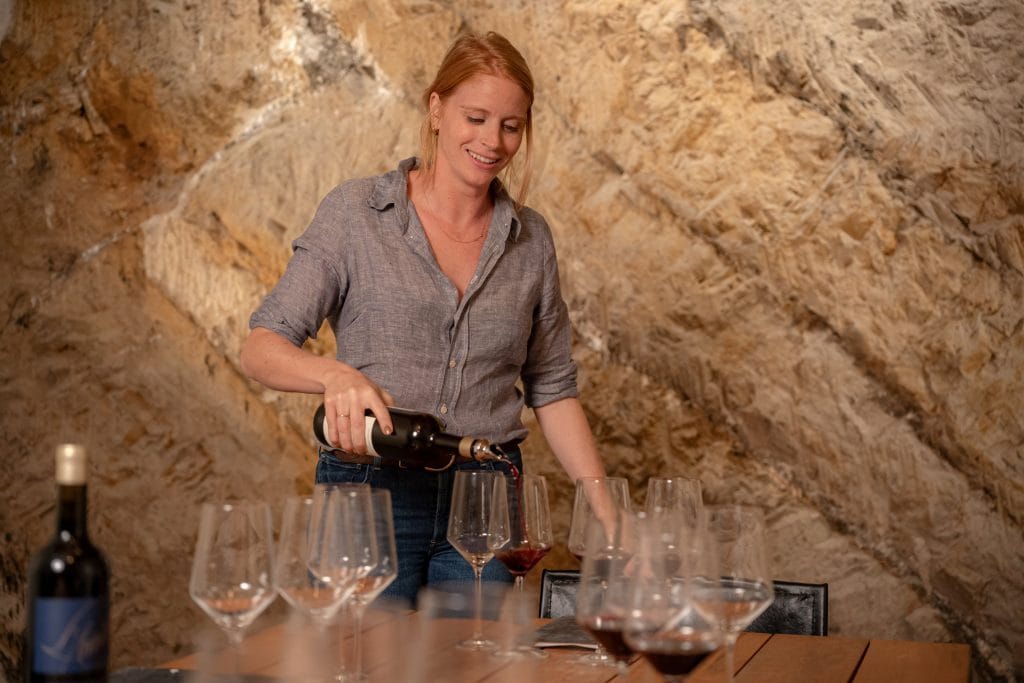
Each vintage, different grape varieties—and different parcels of the same variety—are fermented separately. Stephan, Chloé and the team then meet to select the blends in blind tastings; when they cannot agree, they also turn to Beatrice. For some wines, varieties and parcels are fermented separately and blended later. In others, the grapes meet in the fermentation tank itself, when different varieties, and sometimes fruit from different parcels, are co-fermented.
Power Learns Restraint
Each vintage, different grape varieties—and different parcels of the same variety—are fermented separately. Stephan, Chloé and the team then meet to select the blends in blind tastings; when they cannot agree, they also turn to Beatrice. For some wines, varieties and parcels are fermented separately and blended later. In others, the grapes meet in the fermentation tank itself, when different varieties, and sometimes fruit from different parcels, are co-fermented.
L’Aventure Wine Tasting
The young wines, especially the 2023 Cabernet, struck me as powerful and austere. But tasting the 2018 vintage demonstrated how richness and tannins come together over time. Chloé herself generally prefers to drink the family wines after six to ten years of aging. Estate Reserve 2023, which has just received 100 points from critic Jeb Dunnuck, still needs time in the glass—and perhaps several more years in the cellar.
Wine | My Score | My Tasting Notes | Critics’ Scores |
Côte à Côte 2021 | — | Full-bodied and powerful, with a somewhat rounder feel. | JD 97; WA 96+ |
Côte à Côte 2023 | — | Black fruit and black pepper; pronounced structure. | VN 95; OB 96 |
For Her 2021 | 95 | Emerging complexity, ripe fruit, full body and a pleasingly expansive palate. | JD 98; WA 95+ |
For Her 2023 | 95 | Crème de cassis aromas; one of the standouts of the tasting. | VN 97; OB 97 |
Estate Cuvée 2020 | — | Fruit, softness and a velvety texture, along with power and tannins. | WA 99; VN 97 |
Estate Reserve 2023 | 94–95 | Full body, fruit, power and tannins. Too young to assess fully. | JD 100; JA 99 |
Estate Cuvée 2018 | 95 | Power and a long finish; softening tannins and a harmonious character. | JD 100; WA 95 |
Cabernet Sauvignon 2023 | — | Very powerful, youthful and austere; firm tannins and prominent oak. | VN 96; OB 98 |
Cabernet Sauvignon 2018 | 94–95 | Black fruit, full body, generosity and power; harmonious, with a lingering finish. | JD 98+; WA 94 |
WA – Wine Advocate; JD – Jeb Dunnuck; VN – Vinous; OB – Owen Bargreen; JA – Jane Anson.
Between Vineyard and Kitchen | Les Petites Canailles
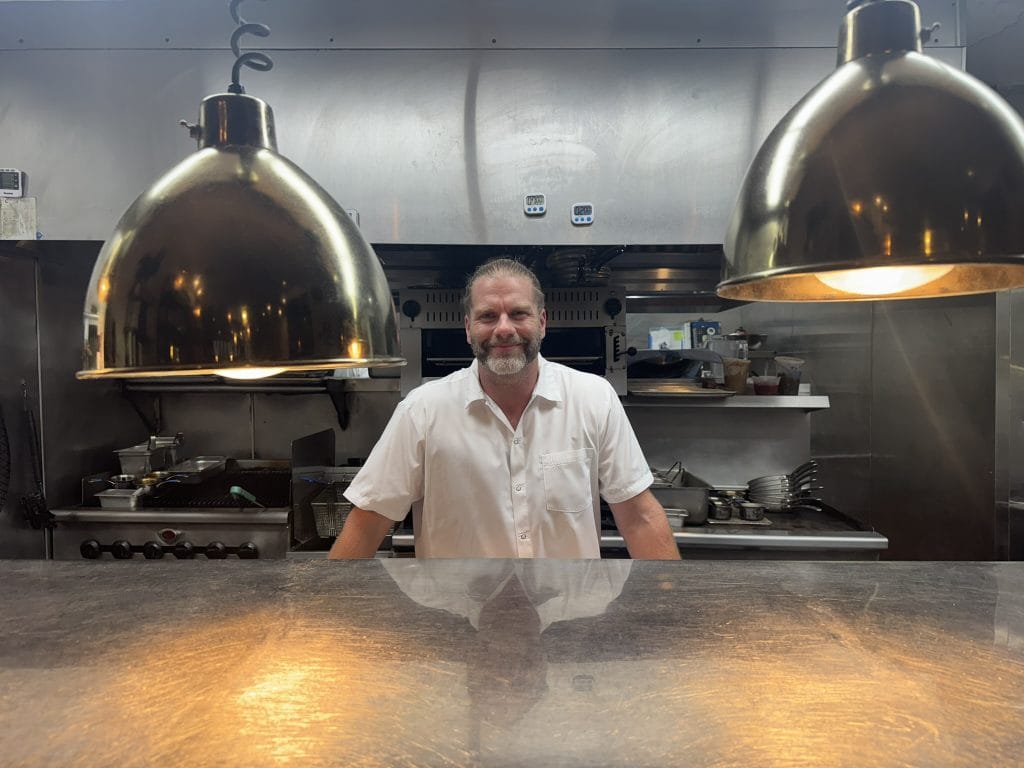
Julien Asseo, Chloé’s brother, grew up in a family where wine was inseparable from everyday life. His grandfather made wine in Saint-Émilion, his father Stephan established L’Aventure in Paso Robles, and Julien himself helped with vineyard work and the harvest as a child. Continuing the family tradition seemed the obvious choice. Yet at just 15 he decided that the kitchen, not the cellar, was his calling. After working alongside leading chefs around the world, he opened Les Petites Canailles in Paso Robles. Wine, he says, was always present, but cooking was—and remains—his first love.
Running the restaurant drew him back into wine from an unexpected direction. As a child he knew the world of those who grow grapes and make wine; today he is also learning how wines are selected, sold and served to diners. In recent years, wine has become a genuine second passion. Burgundy, for example, is now almost an obsession: roughly 15 pages of the restaurant’s wine list are devoted to its wines.
The entire list runs to about 60 pages. Alongside famous names, it aims to introduce guests to smaller, lesser-known producers at a range of price points. The recognition it has earned from Wine Spectator—a Best of Award of Excellence—pleases him, but it is not what drives the effort. For Julien, food and wine do not compete for the starring role. The magic of a good restaurant lies in their meeting, and in the people gathered around the table.
Asseo sees the same diversity as the secret of Paso Robles’ appeal. Unlike Napa, which he associates chiefly with Cabernet Sauvignon, within a short distance here one can visit wineries offering radically different interpretations of the same region. And a Michelin star? He would be happy to receive one, but will not change his cooking to chase it. To him, a full dining room and guests who return are the most meaningful recognition.
Restaurant website: Les Petites Canailles
Epoch Estate Wines
“I want to capture all the wonderful fruit and sunshine we have in Paso, while also making wines with depth and presence—earthiness, minerality, texture and vitality.”
History Returns to the Vineyard
Bill Armstrong grew up in Texas drinking beer and tequila. It was only in his late thirties, when an excellent Napa Cabernet was served at a business event, that he fell under wine’s spell. He and his wife Liz, both geologists and entrepreneurs in the oil industry, decided to search for land where they could create wines capable of competing with the finest from Châteauneuf-du-Pape. In 2004, they found what they were looking for in the limestone hills of western Paso Robles.
An Engineer Who Thinks in Lines and Shapes
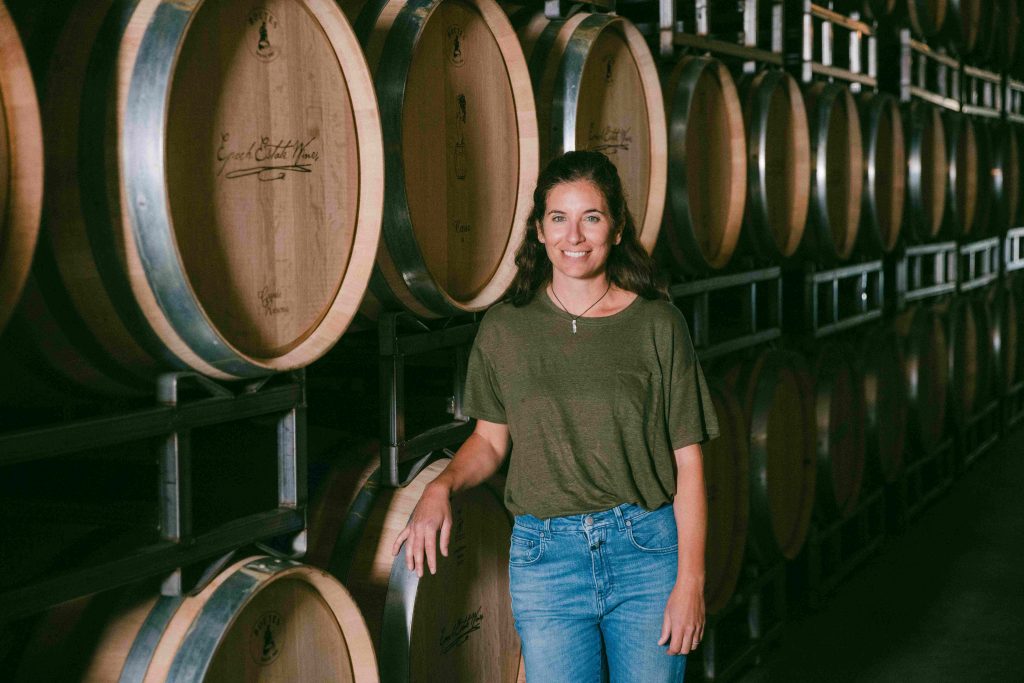
In 2010, the Armstrongs met Jordan Fiorentini, then a senior winemaker in Sonoma, for a job interview on the porch of a trailer in the vineyard. She left the security of her established career to help them build the winery. Born Jordan Kritzer into a Jewish family in Atlanta, Fiorentini grew up in a home where a love of wine became a family business. Her father, Craig Kritzer, left a career in law to establish a winery in the mountains of Georgia. His daughter, who studied engineering and art, followed him into winemaking.
Jordan brings science, intuition and art together in her winemaking. More than a decade ago, she began translating her sensory impressions into abstract drawings that she calls VINPRESSION. Each drawing is a kind of map tracing the wine’s journey from the front of the palate through to the finish. Rounded lines convey softness, fullness and richness; sharp angles and pointed lines express tannins; acidity pulls the sensation upward and shapes the way the finish unfolds in the mouth. The drawings are made on a system of four quadrants, allowing the sensations of wine to be described in different areas of the mouth. Each wine receives its own image, a kind of sensory fingerprint. The result is an intriguing union of art and winemaking: an attempt to give tangible form to an experience that is difficult to put into words, and to create a visual memory of the wine in the glass. Bill encouraged her to make this private language part of the winery’s dialogue with wine lovers.
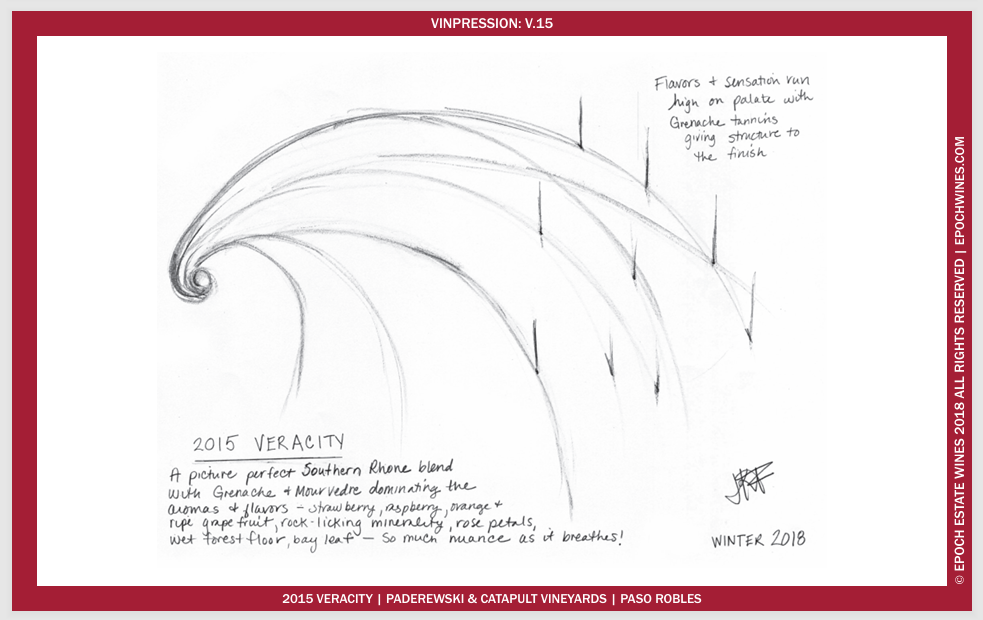
A Difficult Vintage, Two Giants
In the hot 2022 vintage, the team decided to sacrifice a substantial portion of the crop and select only the finest parcels and vines. Production consequently dropped significantly, but the results in the glass were impressive. I told Jordan what I thought of the 2022 wines she had crafted: “You are a magician!” Producing such good wine in a difficult year is no small feat. Nearly every wine I tasted at the winery was wonderful. At the end of the tasting, I returned to two particular favorites—Block B and Zinfandel 2022—to decide which was better. Both were giants in my eyes. I could not choose between them.
Epoch Wine Tasting
Wine and Vintage | My Score | My Tasting Notes | Critics’ Scores |
Veracity 2022 | 93–94 | Powerful dark fruit, with limited complexity. | JD 97; WE 96; WA 95 |
Block B 2022 | 95 | An intense, complex nose; power without heaviness and an exceptionally long finish. Outstanding. | JD 97; VN 94; WA 94 |
Zinfandel 2016 | 94 | A wonderful wine; complex and relatively restrained, yet still powerful, with a pronounced tannic presence. | JD 96; VN 95; WA 93; WS 92 |
Zinfandel 2022 | 95 | Complex aromas, pepper, full body and power; chewy tannins and a lovely finish. | JD 97; WA 94+ |
Possibility 2016 | 94 | A fortified dessert wine in the style of Port; ruby color, full body and impressive power. | — |
Abbreviations: JD – Jeb Dunnuck; WA – Wine Advocate; WE – Wine Enthusiast; WS- Wine Spectator; VN – Vinous.
Winery website: Epoch Estate Wines
MAHA Estate and Villa Creek Cellars
“When you have exceptional raw materials, you don’t need to do much in the winery.”
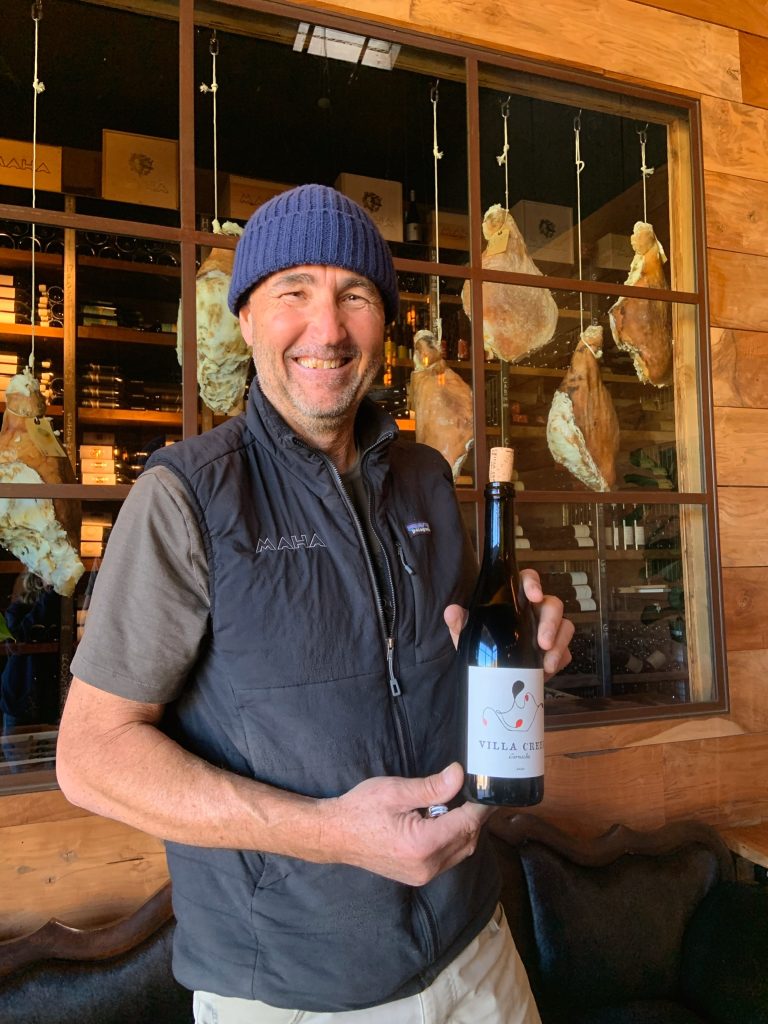
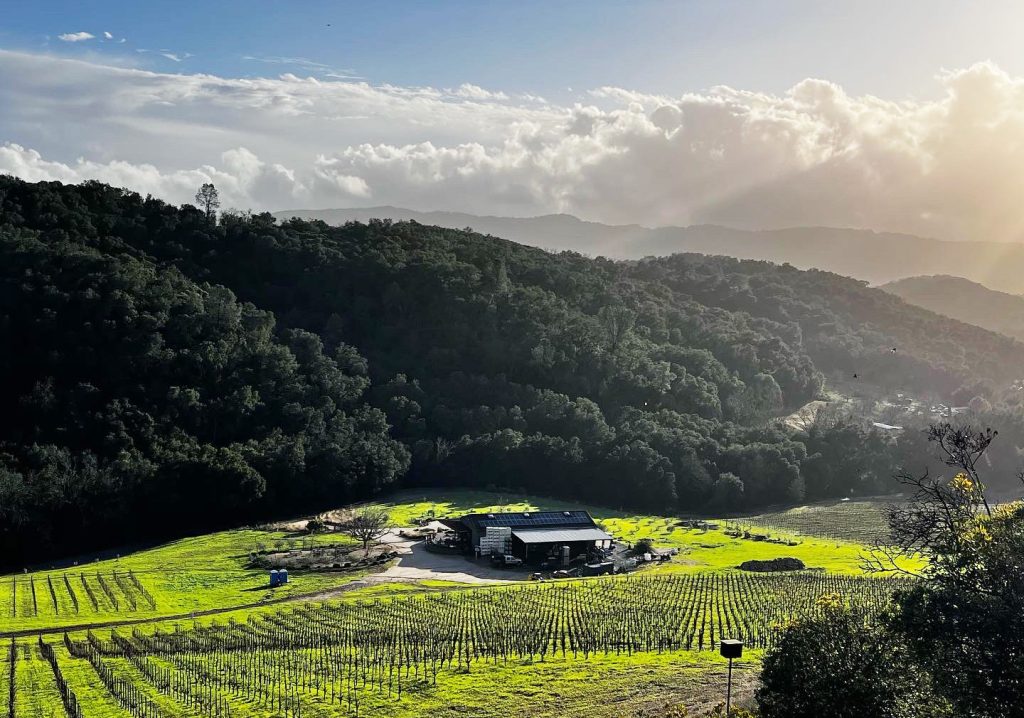
Cris Cherry came to wine from the kitchen, not from a school of enology. In the late 1990s, he and his wife JoAnn opened Villa Creek Restaurant on the main square in Paso Robles, and it became a gathering place for the region’s young wine community. Among those who met around its bar were Justin Smith of Saxum and Matt Trevisan of Linne Calodo; rare bottles changed hands and new ideas were born. Cris and JoAnn even spent evenings helping their friends with winemaking, sometimes bringing their two young children along. When they set out to make one barrel of wine for the restaurant, the project grew to seven. After a Wine Spectator critic wrote about the wine, orders began to arrive. Thus the Villa Creek label was born with the 2001 vintage.
In 2003, the couple purchased another estate, later named MAHA in memory of its previous landowner. The restaurant closed in 2017, allowing Cris to devote himself to vineyards and wine. Today, Villa Creek also produces wines from grapes purchased from selected vineyards in the area, while MAHA seeks to express the family’s own land.
When Power Gives Way to Finesse
Cris admits that his early wines were big and rich, sometimes reaching around 16% alcohol—a style that characterized Paso Robles in the early 2000s. His tastes have changed. Today he seeks restraint, freshness and layers of aroma that come from more than sheer fruit concentration. He explains the evolution through the culinary world, which he knows so well: a young chef may feel compelled to demonstrate every skill in every dish; a mature chef can serve a simple omelet and trust exceptional ingredients. It is the same with wine. In this warm region, he says, making powerful wines is easy. The real challenge is achieving elegance. The distinction was evident in the tasting, especially compared with the more concentrated wines I had encountered at other local wineries.
Living Soil and Passing the Baton
The vineyard is farmed using organic, biodynamic and regenerative methods, but Cris refuses to be captive to any doctrine. He respects the lunar calendar and biodynamic preparations, yet if work is needed in the vineyard on a day when the calendar advises against it, the work gets done. Winemaker and vineyard manager Oliver Mikkelsen shares the aim of leaving healthier soil to future generations. The family’s loss is still felt following the death of JoAnn, who had been a full partner in building the business and shaping its identity. Their children, Camille and Henri, now hold key roles at the winery.
Passing the baton is not limited to family members. Cris also allows Oliver to make wine at the estate under his own independent label, Landsby—Danish for “village,” a tribute to his father’s roots.
MAHA Wine Tasting
MAHA produces two red blends that reveal different facets of the same estate. Understory, based on Grenache, Carignan and Mourvèdre, expresses its floral, fresh and refined side. Backlit, led by Syrah and Petite Sirah with other varieties, is darker, more structured and muscular—but not without restraint. Tasting the 2022 and 2023 vintages side by side was illuminating: 2022 was hot and difficult, whereas 2023 enjoyed much cooler, more favorable conditions. Even so, the 2022 wines retained vitality and balance. I particularly loved Understory 2023, which reminded me, in some ways, of Burgundy.
Wine and Vintage | My Score | Tasting Notes | Critics’ Scores |
Understory 2022 | 94 | Balanced and refined; a fine achievement in a hot, challenging year. | — |
Understory 2023 | 95 | Especially floral and elegant, with depth and a silky texture; reminiscent of Burgundy. | — |
Backlit 2022 | 92 | A fragrant nose, spice and tannic structure; power without heaviness. | — |
Backlit 2023 | 93 | Body and presence, but also restraint; youthful and tannic, with potential to develop. | — |
Landsby 2023 | 95 | Oliver’s personal blend: structured Cabernet alongside Syrah’s fruit and softness. | — |
Landsby is Oliver’s independent label, not a MAHA wine.
Winery website: Villa Creek Cellars / MAHA
The Canyon Villa | A Little Piece of Tuscany
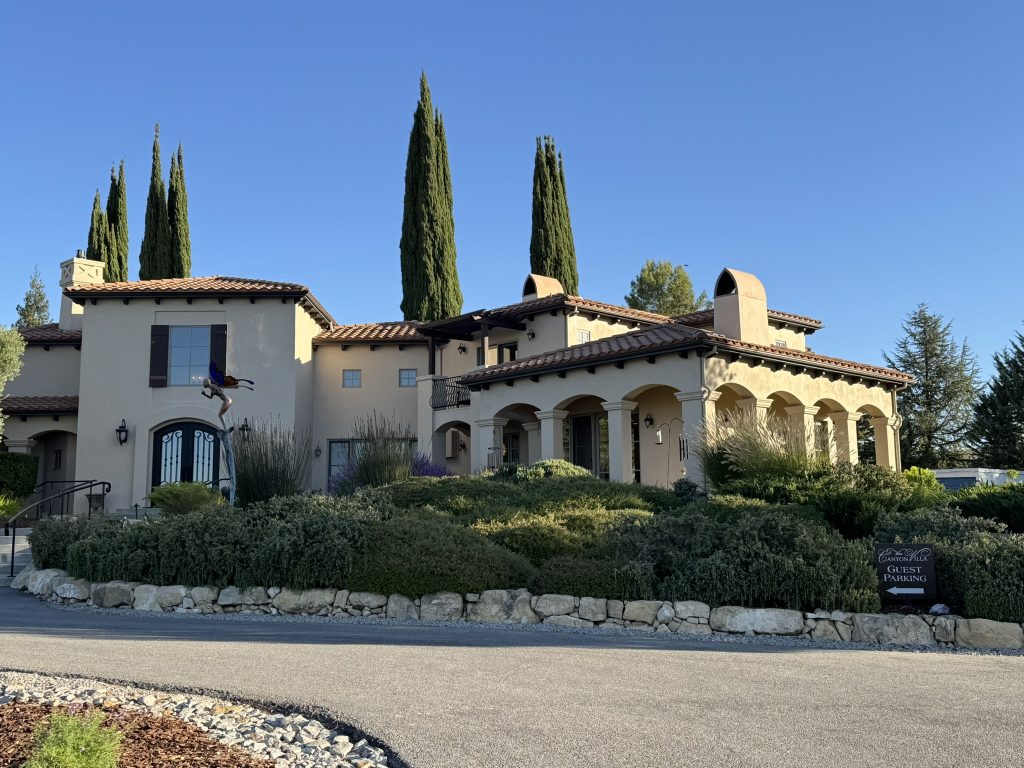
Perched on a hill overlooking the vineyards and olive groves of Paso Robles is a charming little boutique inn that looks as though it has been transplanted from the hills of Tuscany. Set on a lush, peaceful estate, the inn has just four rooms. But its greatest charm is not the view—it is the hosts.
Wills Carter and Katherine Bloxsom-Carter, a couple in their seventies, run the place with exceptional warmth and devotion. Wills, a professional chef with decades of experience in the culinary world, makes no secret of his delight at the opportunity to continue cooking for his guests. His elaborate breakfasts are part of the stay, and he also prepares Tuscan-style dinners on request.
Every afternoon, guests from the four rooms gather for a tasting of wines from nearby wineries, accompanied by cheeses and small bites prepared by the chef. Included in the room rate, the gathering quickly turns into pleasant conversation around the table. Instead of another luxury hotel, the couple offer something increasingly rare: a personal, almost family-style welcome from hosts who are genuinely happy you came.
The Canyon Villa, A Luxurious Inn
1455 Kiler Canyon Rd, Paso Robles, CA 93446, United States
Daily wine tasting, 5:30–6:30 p.m., included in the rate.
Three-course breakfast included; special dinners available by prior arrangement at an additional charge.
Telephone: 805-238-3362
Map of the Paso Robles Visit
View in Google Maps – five wineries, one restaurant and one hotel
Note: Saxum is not currently open to visits by the general public.
